

The AI boom is real. So is the risk.

Updated: Aug 10
Artificial intelligence is the most powerful investment story of our time, and it is not hype. The infrastructure being built, the chips, the data centres and the hyperscalers, is real and it is enormous. Which is exactly why it has become crowded. A small group of names, led by Nvidia and Microsoft, now drives the bulk of US index returns, and a generation of younger investors is rotating out of traditional diversified portfolios and straight into the AI trade.
When a whole market leans on a few stocks, the story can be right and the price can still be wrong.
The US market is priced for perfection
You do not have to guess whether the market is expensive. You can measure it. Across six widely followed long run models of US stock market value, five now read overvalued or strongly overvalued.
The Buffett Indicator sits at 219 per cent. Total US market value divided by GDP is about 2.1 standard deviations above its long run trend. Warren Buffett once called this the best single measure of where valuations stand at any given moment.
Price to sales and mean reversion are strongly overvalued too. On almost every long run measure that has ever mattered, the market is trading well above where history says fair value should be. At the same time, the US yield curve is signalling very high recession risk, and margin debt, the money investors borrow to buy shares, is flashing optimism. That is the classic late cycle mix.
Australia is not the United States
Here is where it gets interesting for us. On five long run valuation measures for the Australian market, the composite currently sits about half a standard deviation above fair value. In plain terms, fairly valued. Not cheap, but nowhere near the extremes of Wall Street.
So the picture is not sell everything. It is know what you own, and know what it is priced at. A typical globally diversified portfolio today can carry a great deal of concentrated, expensive US risk without the investor ever choosing it.
The trigger most people are not watching
Ask what actually brings an expensive market back to earth and the answer is rarely the thing in the headlines. It is usually rates. Here is the chain that matters. If the conflict in the Middle East flares again, oil and shipping costs climb, inflation reappears, and the United States is forced to price interest rate rises back in. You can watch that shift happen in real time on the CME FedWatch tool, which tracks the market's own probability of the next Federal Reserve move.
Higher yields are precisely what a market priced for perfection struggles to absorb, because the most expensive growth stocks are the most sensitive to a rising discount rate. This is exactly the kind of second order chain, geopolitics feeding through to inflation, then rates, then valuations, that the former diplomats at Geopolitical Strategy, where our Founder and Chairman Bill Moss AO is a senior advisor, are built to see coming.
We are not trying to call the top of the AI boom. We are trying to make sure your outcome does not depend on it.
What we are doing instead
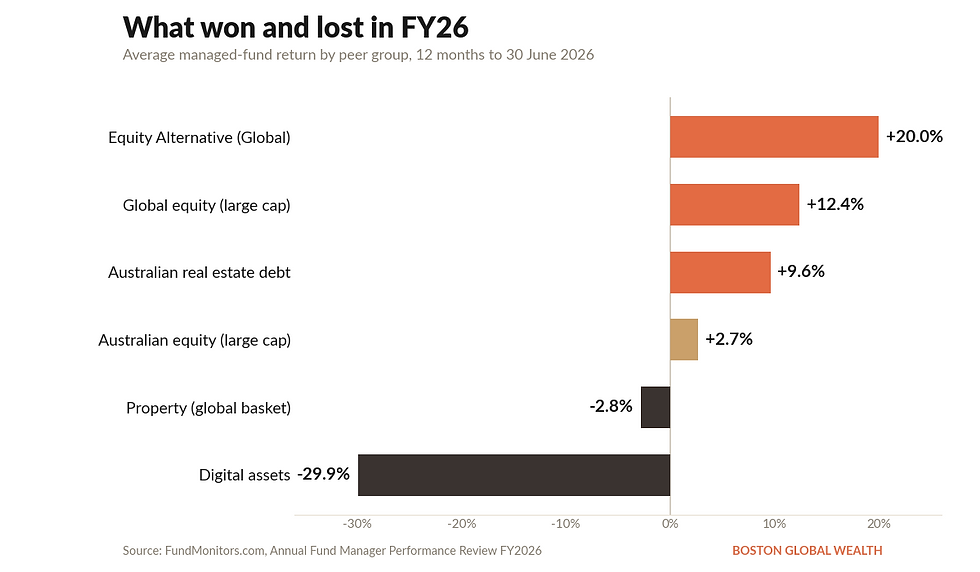
A snapshot of the kinds of strategies we have been reviewing. Rather than crowd into the same few names at these prices, they take AI exposure where it is less crowded, and build the rest of the portfolio to withstand exactly the risk above, higher inflation and higher rates, rather than be sunk by it. Managers are not named. The pattern is the point.
Own the picks and shovels, not the hype. Rather than pay peak multiples for the most crowded chip and platform names, take AI exposure through the infrastructure layer, the powered land, data centres, cooling, grid connections and copper the boom physically cannot run without. As the AFR argued this month, in every build out the enabling infrastructure often delivers the more durable returns.
Lend at rates that reset upward. Private credit coupons float over the cash rate, so when the market prices in higher rates the income rises rather than the capital value falling. One residential real estate debt strategy we reviewed sits at the front of the capital stack, targets about ten per cent a year net, and has had just two negative months in almost eight years.
Own income that is contractually linked to inflation. One global infrastructure strategy we assessed earns roughly ninety per cent of its revenue from contracted or regulated assets, with about three quarters of that income rising with inflation. If war pushes prices up, the income follows rather than falling behind.
Hold what does not care about the Fed. Insurance linked securities and catastrophe bonds behave like floating rate notes, so rising rates lift their yield rather than dent it, and their payout depends on natural events, not on Washington or Wall Street. Gold, meanwhile, quietly hedges the inflation and currency debasement that tend to follow when governments face both war and debt.
This debate is live in the AFR right now
The same questions are playing out in the financial press this fortnight. Worth a read:
Why Australia is the world's most underappreciated AI trade.
Bubble busters or broken clocks: when the market bears are early, or wrong.
Investors looking for shelter from the AI storm are turning to India.
How we think about it at BGW
If a large share of your wealth is riding on US shares, directly or through your super and managed funds, it is worth understanding exactly how concentrated and how expensive that exposure has become. That is the kind of work we do for clients, across listed and private markets, sized to each client's portfolio and wholesale eligibility. It is a conversation, not a product.


Comments